Monday, February 9, 2015

So, you want to be a black belt, huh?


So you want to be a black belt?

There are many things about martial arts which are silly, confusing and even misleading.  We may think we know what we’re talking about, but to a layman it must sound like gibberish.  However, if we really stop to listen to ourselves, to really think about what’s commonly said or written, we may find that we really don’t understand.  Our Soke is a master at this, where we read or hear something and think we understand – only to gain a totally different interpretation and understanding later on.

One big stigma that falls into this is the subject of belt ranks.  It seems that, particularly in the Bujinkan organization I belong to, there are so many mixed messages regarding the importance of rank.  You’ll hear people say rank doesn’t matter.  You’ll hear people say rank is a personal thing between teacher and student.  You’ll also hear people talk about the yearning to be a black belt.  That latter part is what I want to write about here.

What does it mean when someone says they want to BE a black belt, anyway?  Are they really saying they want to be a strip of black cloth that’s tied around the waist of someone?   I doubt it, although nothing surprises me.

I believe most people have some sense of what kind of person is a black belt wearer.  For a new person, that usually means some kind of measurable skill level beyond just a basic grasp of techniques.  Some may even think it denotes a kind of mastership.  But, if we consider this from different perspectives, we begin to see that a black belt really isn’t a very concrete thing.

In a curriculum based school, a black belt is an achievement based upon learning and adequately performing the material required for the black belt.  It’s a narrowly defined purpose and result.  Other schools may be more holistic, focusing on gaining some level of understanding of principles, demonstrated in a broader range of physical expressions.  Some may go so far as to not have any requirements, basing ranking purely on the subject opinion of the teacher or recommendations from a panel.  In our Bujinkan organization, we have all the above, making the image of a Bujinkan black belt something that isn’t so clearly defined.

When a new student expresses a desire to “be a black belt”, I feel some questions need to be asked.  What do they think being a black belt means?  Why is that so important to them?

If one wanted to EARN a black belt, then they are saying a very specific thing.  But, to BE a black belt is relating more to an ambiguous quality they wish to embody in themselves, an archetype of what they believe a black belt student should be, which could encapsulate a wide variety of images.  To BE a black belt is to conform themselves to their own fantasy image or expectation.  To EARN a black belt means they conform to what the school or teacher demands in order to receive a black belt.  Although a student may often pursue both aspects while achieving the goal of obtaining a black belt, the difference is important.

In my opinion, a student receiving a black belt needs to be satisfied with both BEING and EARNING the belt.  Anybody can put on a black belt, but in so doing fraudulently, they are not BEING a black belt and they certainly haven’t EARNED it.  But, one can earn a black belt and fail at being one.  Many work hard to earn their black belt, but because they have made the mistake of placing too much importance on receiving the belt and not being the kind of person who has one, they end up stopping there and never progressing.  Some even experience depression and frustration, due in large part to the black belt not meeting their self-created expectations of what it is.


What, then, does it really mean to BE a black belt?  That means not only earning it, but maintaining the same passion, drive, focus and hard work it took to get there.  This is what takes you into the various grades of black belt.  It takes being a diligent student in order to EARN a black belt, but it also takes being a diligent student to BE a black belt.

So, contrary to the current popular opinions, rank does matter.  But, it’s HOW it matters that the importance is placed.  Rank should be something earned, but not as a one-time trophy or status or some kind of possession.  It should be a measurement of your knowledge, skill and experience.  At the same time, it should be something that fits what a person of that rank should be.  Who sets that expectation?  It is a combination of what you place on yourself and the expectations of your teacher.

Earning ranking isn’t something you do every few months or whenever testing is conducted, like passing an exam for a class.  You are tested on it every day, every time you step onto the mat.  You are challenged not only with learning the skills it takes to reach that belt rank, but also in maintaining those skills.  From there, you have a platform to build upon, to grow into the next higher rank.  But, if you sit back on your ranking, putting in just enough to maintain without continuing to refine, stop learning new things and not growing in knowledge, skill and experience, you have failed at being a student.

And being a student is at the core of being a black belt.  Being a student is to have passion for learning, the commitment to train honestly and with determination, and having the patience to keep going without settling or letting the rank become a resting point.

The process from white belt to black belt is deeply personal and contains many challenges.  It is the fire of challenge and trials that creates growth.  When a new student begins, they will have an understanding of what earning and being a black belt means.  However, as they progress, their own image of what it means to be a black belt will change.  This is important, as it should serve to guide them, like a beacon on a hill or an example to model themselves after.  At the same time, they learn new skills and build confidence when they see themselves executing them with greater efficiency and ability.  But, as they progress, they discover there are always levels beyond what they thought they knew and, in that, they begin to see that there is a balance between quantity and quality.  That hunger to evolve the techniques they know, to reach those deeper levels, becomes weighted against learning more and more techniques.

In those pursuits, the meaning of ranking may change and carry less importance.  For some, they are still clinging to ranking over the substance of their training, showing it’s more important for them to receive ranking than to grow as a student.  Instead of looking to sempai (seniors) and sensei (teachers) as examples to try and emulate, they look to curriculum and textbooks for technical data in order to do just what they need to earn the next ranking. 

They are chasing the belt instead of the art.  They may earn their black belts, but they will likely fall short of being black belts.

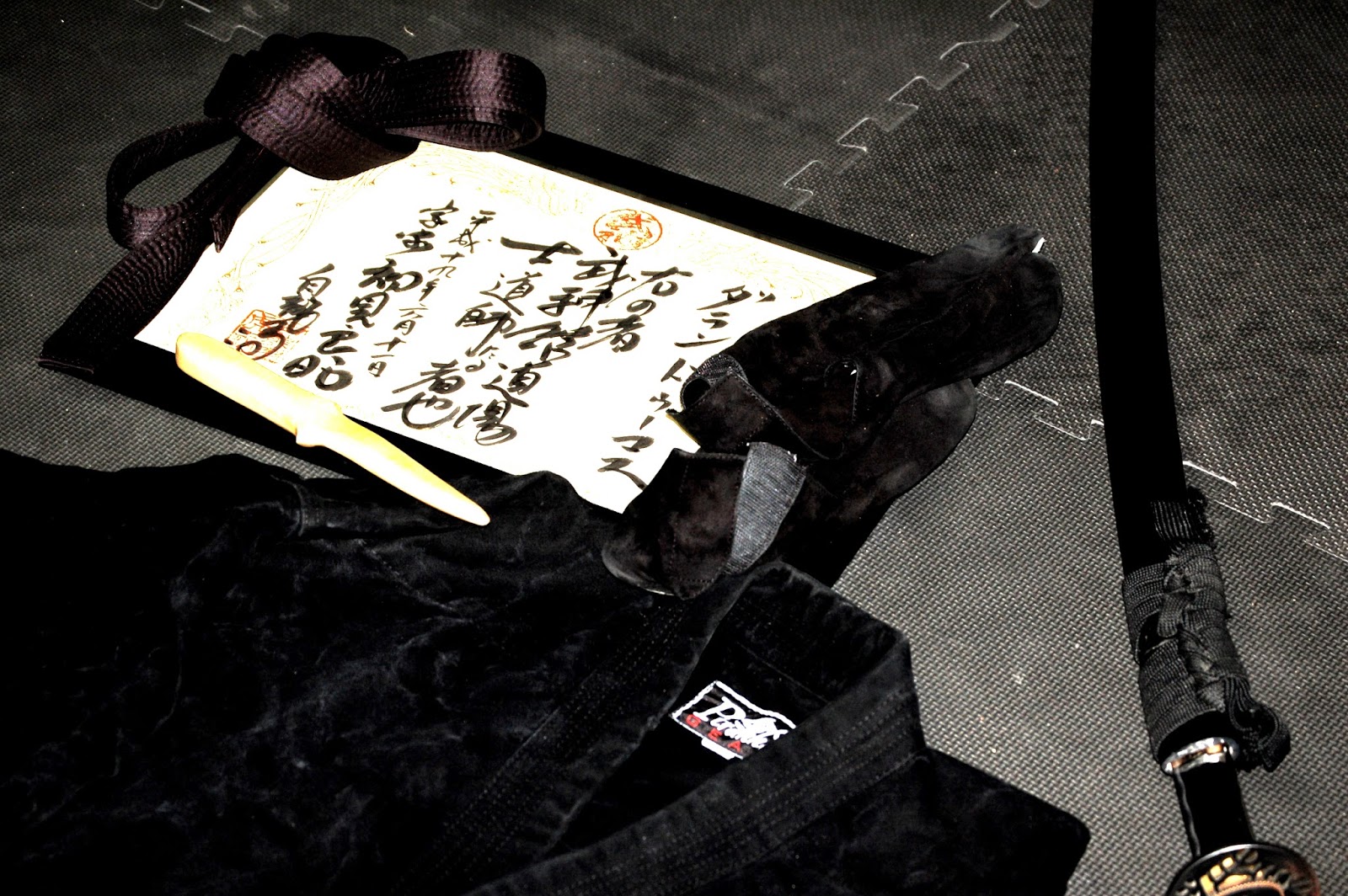
So, you want to be a black belt?  Start by being a student and never stop being that student.  Understand what it takes to earn a black belt from the teacher you choose to learn from.  Then, train as hard as you can and let it come to you through your actions.  The day they put a black belt around your waist and give you your Shodan menkyo (certificate), you’ll experience a new struggle.  Everybody goes through it, some more than others.  You will have three things going on at the same time, some stronger than others:


  • You’ll wear your black belt as a symbol of your status, with an expectation that you are now proficient and an example for others.  Instead of looking ahead to what’s next, you’ll want to show off what you have now.
  • You’ll feel like you haven’t truly earned what you believe a black belt to represent.  You’ll even feel somewhat embarrassed or ashamed to wear that black belt for the first time in class or have others refer to you as a black belt.  You’ll train hard, trying to embody what you think you should be like in order to feel good about wearing that belt.
  • You’ll just put it on and keep going, giving it little thought.  You just see it as recognition from your teacher, nothing more, and you just keep showing up and training hard like you have all along.


The problem with the first two is that they both place the belt rank in too high of importance.  Whereas, the first attitude will eventually cause a student to fade away from training, the second could lead to quitting out of frustration.  It could also lead to a serious lack of confidence, real confidence that one needs to have to be a strong budoka.  Humility isn’t the opposite of confidence, so don’t confuse the two.  The third one is the rarest, but likely more indicative of what a successful, lifelong student embodies.  However, few, if not most, never can really have that as their main perspective.   

We all have a mix of the three.  I can attest to times when the first two were dominant.  For me, often the higher rankings I’ve received have left me feeling inadequate.  I felt I hadn’t quite earned it yet, so I would keep training.  That’s a good outlook, but if I never felt adequate for my rank, then I risk feeling like I’ve wasted my years of training.  At some point, I need to accept the recognition from my teacher and keep training.

What I never want to do is to settle or rest myself on my rank.  Of all the three, that one is the most devastating to a martial artist.  Yet, we do have moments where we enjoy our new rank, where the ego prods us to believe we are better than a Kohai (junior student).  It happens to everybody, including me, and I have to just get with my Sempai and Sensei to realize I have so much more to learn and grow that I can’t afford to sit back and coast.  In that regard, rank doesn't really matter, then, does it?

So, I just accept what I am given and keep going, because I know that regardless how high of ranking I may receive, there will always be an endless path lying before me, drawing me deeper and deeper ahead in pursuit of knowledge, skills and experience.  There is no belt, no rank, no certificate, which can replace the fire of that passion and the personal rewards of that endeavor.  That's the secret to belt ranks and something that may be intellectually understood, but has to be experienced to be fully embodied in the heart.

Thursday, January 15, 2015

Wake Up and Live!


“To be “awoken” in martial arts means to be attentive, on guard, to be alert in any situation, whether it be a physical or emotional conflict.” – Dr. Kacem Zoughari


You can say this is a sort of Zanshin, or heightened awareness of everything around you and within you.  I’ve felt this at various states many times in my life.  For seemingly unknown reasons, suddenly I became acutely aware of everybody and everything in the room.  Through all the mixed laughter and conversations, I could pick out key phrases and words.  There was a spike in the energy of the room and I felt it.

I’ve felt this many times.  Most of the time, it goes away without any sort of idea why it happened.  But, in other situations it precluded some sort of danger.  I can remember being in a noisy bar and having my attention instantly expanded into the room, hearing words that carried the tone and language of aggression.  Two men were squared off and ready to fight each other.  Fortunately, in this situation at least, cooler heads prevailed and the situation didn’t turn violent.  But, not all have ended that way.


I remember another situation from my days catching crooks where I had a young male suspect detained.  He was cooperative and not resistant, but somehow my senses were pinging.  I was uneasy and felt I needed to search him closer.  As I conducted a more thorough pat down search, I felt a lump in his sock, just under his pant leg.  It was a knife!  I had missed it in my initial search, because I was only doing a cursory pat down of his waist.  Was I reading his intent?  Would he have tried to deploy it against me?  I don’t know.  Nothing else gave me any indication of the threat, except for a feeling.

There are many such examples, but as I stated, most I have no idea the reason for a spike in awareness.  However, I don’t take it lightly when it does happen.  I also don’t become paranoid, either.  I just accept the feeling and embrace the increased awareness without making any assumptions.  I think that last part is the most important.

In training, many times I can see the awareness heighten – and deaden.  I’ve seen people glaze over, or be focused elsewhere, instead of on the lessons being presented.  Our Soke has mentioned numerous times how he doesn’t teach, about how we have to “steal techniques”, that we’re learning how to “see”, and so on.  When you train in Soke’s class, things move very, very fast and seldom are repeated or explained on a technical, how-to level.  You either catch the moment or you don’t.  That requires a high state of awareness, to have one’s mind awake and receptive, to not only see what’s happening, but also remember it.  This is probably one of the single most important lessons a student can receive.  But, many times people can be overwhelmed, or they get tired and drift.  It is in those moments that secrets can be missed, maybe even a pivotal point that could mean the difference between understanding and confusion.  That moment of dullness in one’s perception and awareness is a Suki, or weak point.  Now imagine if that happened while a criminal approached you with a knife concealed in his hand.

However, to be paranoid is just as dangerous.  It makes you assume, overreact and narrow your awareness and attention to singular things.  There’s a balance to be made here.  Being “awake” has more to do with a state of being than an act.  Thus, it should require conscious mental energy to be that way.  It just is.  But, we also use our mental energy to keep our awareness up, to not allow ourselves to slip into an under-attentive or overly-attentive state.  Our mind is the rudder, keeping our consciousness on the natural course and making small adjustments to maintain our heading.  The best pilots use little energy, making subtle and very small adjustments.  This requires lots of focused training and valuable experience.

So, how does one “awaken” in their budo path?  First and foremost – pay attention!  Practice self-awareness of the shifting acuity of your perception.  In other words, don’t let yourself drift off in thoughts during class or when out and about in your day to day activities.  Be mindful of everywhere and everything without being paranoid.  Be mindful of when you are starting to fade and nudge yourself back to awareness.  Again, you aren’t making any assumptions or reading into anything.  You are just being aware and allowing those perceptions to run inside you without attaching anything to them.  If those perceptions urge you to act, then you act.  The difference is you aren’t using your mind to “tell” yourself to act.  You just act.  You are trying to build a connected relationship between your awareness, your perceptions, and your actions that isn’t dependent on the conscious mind to direct it.

If you want an experiment to see where you are in this ability to stay “awake”, take a basic solo kata or technique and practice it over and over again.  Do it a hundred, two hundred, three hundred times or more.  Grab your wooden training sword (bokken) and just practice downward cuts over and over for a thousand repetitions.  While you are doing these, you are focused on your technique, your breathing, your balance and so on.  At what point do you find yourself drifting off, becoming bored or thinking of other things?  That’s your Suki, the weak point in your mind.  That’s where you are falling asleep – and when you will miss a pivotal point.


Once you capture and maintain this “awakened” state, live from it.  Carry it with you throughout your day and let it stay a natural part of yourself.  Eventually, you will always have this going, even while laughing, playing and relaxing.

Being in Zanshin, fully awake inside as well as outside, does not mean you are shifty eyed, tense and ready to fight at a moment’s notice.  It’s quite the opposite.  You are relaxed, free and unattached to fully exist in every moment, at the very point in which that moment materializes.


And if that moment involves danger, you adapt and keep going without any attachment to take you away from fully being in the next moment.


Wednesday, December 31, 2014

My Budo Blog New Year's Message - Reflections & Rebirth, A Humbling Journey


Well, it’s that time again.  It’s time to sit and reflect on how my Shugyo (martial path) has evolved over the last year and try to take a look ahead.  More importantly, it’s time to evaluate mistakes, successes, clues and dead ends.  Last year was quite a turbulent year for me personally and it was reflected in my own training, as well.

I began 2014 with a feeling, or more accurately, a burning need to look inside myself and ask hard questions.  These questions all surrounded one nagging theme of “why”.  Why was I training?  There were many outside influences which helped push my understanding and challenge my own purpose for training and it forced me to look at everything with fresh eyes.  I also had the fortunate opportunity to train with people who were reaching for new horizons, expanding their own understanding and weren’t afraid to break tradition in order to explore possibilities.  All of this helped me in so many ways, too many to try and explain in this blog post, and the fruits of that are still revealing things to me even today.

I made many mistakes, important mistakes, and had my own flaws openly displayed.  Seeing the holes in my own abilities and thinking was not an easy thing for me.  It isn’t easy for anybody, especially when others look to you for guidance and understanding.  But, what it did was enable me to come to terms with my own ego, my own acceptance that I, too, am still a student with SO much more to learn and SO much farther to grow.  I believe it was that humbling process, even if uncomfortable and painful, that broke me out of the rigid shell I had allowed myself to be trapped in.  All my struggles I had written about before suddenly fell away and left me with a renewed sense of purpose and direction.  I had been looking inside myself to find the answers, but I was also seeking solutions outside myself by exposing myself to so many different ways and methods that I had actually created more confusion and struggle.

I was like a ship on rough waters, throwing up sails to catch any wind that came along, and never actually following any charted course.  In that madness, there were discoveries and new experiences, but at the end of it all, I was still a ship lost at sea.

Some things that manifested during the year included moving my classes to my private dojo.  This meant training in my back yard and at a local park by my house, while I worked hard to clear out my garage, purchase and install adequate matting and create a suitable indoor training space before the winter rains would arrive.  This gave us many opportunities to train in different environments, which offered new insights into adapting techniques to meet the environment.  The other result of moving classes to my private dojo is the class size capacity.  I had to decide to cap our class size in order to prevent crowding.  This meant I had to stop actively trying to recruit new students and even turn down some interested prospects.  But, I also felt good about the folks who came with me to train when the Bujinkan Life Dojo facility closed down.  We lost a few students and gained a few.  Those who were along for the journey and left are now on to fulfilling great things in their lives and I’m happy to have walked their path with them for the time they were with me.  All things serve a greater purpose and I like to think their training, although temporary, played a key role in launching them into the new chapters in their lives.  The martial path is different for each person and not everybody devotes their entire lives to walking it, yet all are shaped and influenced by the experiences and lessons gained from walking it.

As 2014 progressed, I had the fortunate experience to train with a very skilled and knowledgeable Shihan who was here visiting from Japan (he is a California native living in Japan) and taught a weekend seminar.  That seminar and the many talks he and I shared helped clarify and solidify many wonderful things with me.  He chose me as his Uke for most of the entire seminar, much to my humble appreciation (and pain!), but in that experience I learned a great deal about the importance of the ryuha kata, why they were written the way they were written, layers of learning progression, and how one should approach study and training to unlock the secrets they contain.  Prior to this, I had convinced myself ryuha kata were dead, something to practice, but quickly discard for more “real” methods.  Yet, training with him reinforced my experiences and shift of understanding I gained from training with another incredibly skilled and knowledgeable non-Japanese Shihan who also lives in Japan, but was out here to do a seminar at our Bujinkan Life Dojo facility.  Those two events cemented really foundational truths I had already known about, but not realized just how much I needed to embody them in my own training – and in my own teaching.  I had spent too much time in my own head, too much in “Play”, and not enough in dedicated practice of things which were handed down by generations of men who had far more real experience and knowledge than even my own long training career (which is somewhere around the 30 year mark!).

The experiences of the last couple years provided a stark reality check of my deficiencies, illusions, and holes in my ability and understanding.  I knew they existed, but because I was too busy trying to patch them up with new ideas and methods, I never bothered to actually dig into “why” they were consistently there.  I was searching outside myself for answers, but the answer really existed inside.  Not to sound confusing, but the real solution that existed inside was discovered through my outside experience in training – not just any training, but training in the foundation of the very art I had devoted so much of my life.  I literally went back to the beginning and found what I needed, what existed there this whole time.  I needed to get to the point I did in order to realize I needed to go back and, when I did, suddenly everything changed and I was now on a new path.

A major part of this new path (Shugyo) was the importance of formality and structure.  I cracked open my old Tenchijin Ryaku no Maki and realized I had collected so many variations, some contradictory, and decided to try and dissect through to get to the most complete or accurate.  A good friend shared with me his copy, which is a direct translation from the original Japanese, as opposed to a translation of a translation of a translation, etc.  When I combined my new understandings gained from those visiting Shihan who taught “by the book”, I found this copy matched exactly what I had learned from them.  Then, something miraculous happened.  I began to see the patterns, the way the techniques were laid out and presented.  I began to understand a new language, not Japanese, but a kind of “budo language” that resonated into me through the details of the various kata, techniques and skill sets listed in the pages of the Tenchijin Ryaku no Maki.  Not to sound weird, but it spoke to me, filling me with an intense inspiration and hunger to dissect and absorb everything from it.  Even what I had considered the most “simple” of techniques listed suddenly became alive.  The one dimensional ink on the paper transformed into two dimensions, as I began to feel the movement and then it became three dimensional, as I felt myself drawn into it, encouraged to explore every detail, to see what was hidden by the one and two dimensional perspective.  Everything took on a newness and I had a clarity of vision I had never experienced before.

I realized I needed to stop “playing” and start digging.  I applied what I was learning into my copy of the Tenchijin Ryaku no Maki, making notes and highlighting details which were important.  My recollections of things past teachers had told me suddenly spilled onto my notes, including nuggets of wisdom and insights from training with teachers in Japan. I found a logical consistency and, when things other teachers have taught me didn’t fit this consistency, I took note of them only as consideration and something to save for later.  I never want to discard something, since I have no idea if it might reveal a new understanding down the road.  But, what I had begun to create was a structured, articulate and consistent method of training and transmission, based on sound teaching from those who I was fortunate enough to learn from.  These were not my ideas, but a carrying on of what others had taught me.

As I watched others train, I began to see similar struggles.  The very gaps and inconsistencies in my ability and understanding were being replicated in those who trusted me with their training.  That made me angry at myself!  I decided right then to devote my classes and teaching to the foundation from which I had made my new discoveries.  I was going to teach from the Ten and Chi Ryaku no Maki, which I believe to be the foundation of our taijutsu, and use ryuha kata to explore further from there.  I made the decision that I would begin to award ranking to those students who wanted to earn it and created a curriculum guide that listed out material from the Ten and Chi Ryaku no Maki for each Kyu grade up to Shodan.  If someone was going to earn their black belt from me, I was going to make sure they had skills and knowledge which were solid and reliable.  They needed to feel confident in their abilities and be able to look back and see what they have learned.  This would require commitment on my part to stick to the book, to not deviate into my own whims and explorations, but to use structured repetition and focused skill development in order to hammer in foundations which are powerful and solid.

However, I can only do so much.  The students need to put in the blood, sweat and tears to actually train enough to reach those levels.  That’s what the ranking would be for.  If someone doesn’t want to do that, it’s okay.  They can train and enjoy the experience. But, those who hold rank will have worked hard to gain it and their abilities will be proof of that.

So, looking into 2015, I see things getting down to the nitty gritty, back to basics, but with a committed passion to really honing in strong skills.  We are going to dig deep into the book, scraping away the ink to find the secrets which lie underneath the surface.  We are going to train hard, condition our bodies and sharpen our teeth.  Our foundations are going to be built strong, with a constant attention to detail.

I am reminded of the Rocky movies.  In it, he goes through great trials to become the champion.  But, then what happens?  He rests on his laurels.  He enjoys the fame.  He softens up.  The fights he does are nothing more than exhibition fights, already set up for him to “win”.  Only when another up and coming fighter, one with the “eye of the tiger”, hungry for the championship, does he suddenly realize how far back he had let himself get.  But, it was too late and he lost his championship title. 
What does he do after?  He ditches the fancy gym, all the glamor and lights, and goes back to his foundation – the old, smelly, run down gym he started in.  He goes back to being a student, listening to his old coach and recommitting himself and putting in the hard, gritty work needed to be a great fighter again.  He regains his “eye of the tiger”, defeats his opponent and regains his championship title.

That’s what I want for 2015.  I want to get that “eye of the tiger” and go back to the gritty, hard work required to be strong budoka.  It won’t be comfortable, but it will be fun.  More importantly, however, it will bring back the life hidden in the old densho, diving beyond the dried ink and into the heart of those generations who brushed those strokes onto the paper.

Hold on tightly – 2015 promises to be one wild ride!